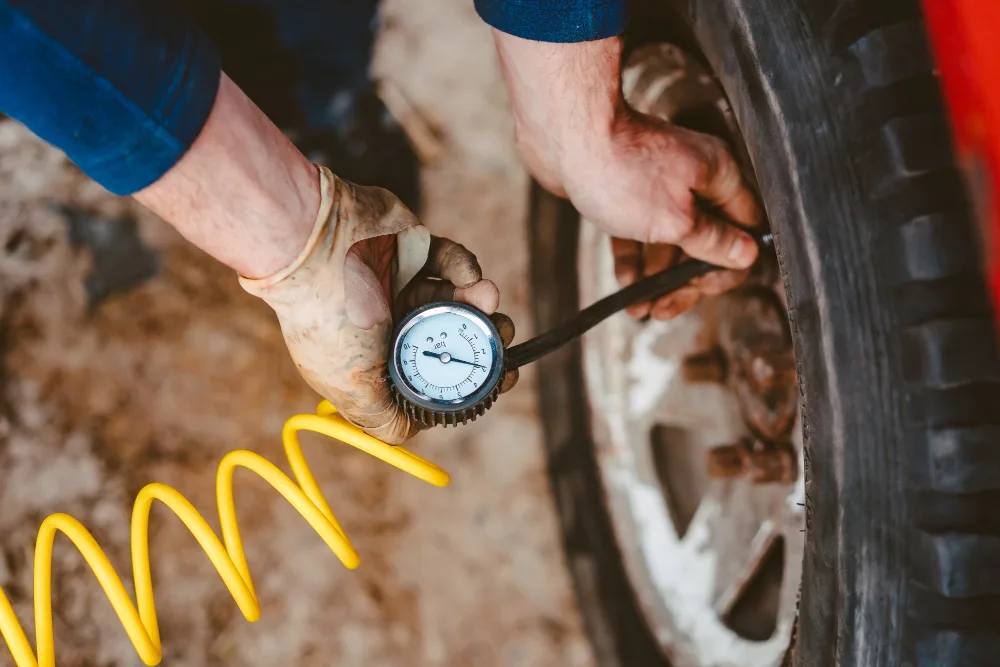
A colder morning can produce a lower pressure reading even when nobody has touched the tire, but temperature should never become an automatic explanation for every warning.
Pressure reflects the condition of the air inside a sealed tire. As conditions change, the reading can move; a puncture, valve problem or damaged wheel can also reduce pressure. The useful response is a repeatable measurement, not adding an arbitrary amount of air. This guide explains the decision process without prescribing one pressure for every vehicle.
Start with the vehicle placard, not the tire sidewall
The recommended cold inflation pressure is vehicle-specific and is normally printed on a placard in the driver's door area or stated in the owner's manual. The pressure moulded onto a tire sidewall describes a tire limit under specified conditions; it is not a substitute for the vehicle manufacturer's target. Front and rear recommendations may differ, especially when a vehicle has different tire sizes or load conditions.
Measure all tires under comparable conditions
NHTSA recommends checking tires when they are cold, meaning the vehicle has been parked long enough for driving heat not to dominate the reading. Use one reliable gauge, record every tire and include the spare if the vehicle carries one. Comparing readings taken after different journeys can create a false pattern because driving warms the tire and its contents.
Treat TPMS as a warning system, not a precision gauge
A tire-pressure monitoring system is valuable because it can flag meaningful underinflation, but the warning light does not replace a manual check. Some vehicles show individual values; others only show a symbol. After correcting pressure according to the manual, follow the vehicle's stated reset or relearn process instead of assuming the light must disappear immediately.
Look for persistence and asymmetry
If all four readings move in the same direction after a major weather change, temperature is a plausible contributor. If one tire repeatedly loses more than the others, needs frequent top-ups or shows visible damage, stop treating the pattern as weather alone. A qualified tire professional can inspect the tread, valve, bead and wheel. Do not drive on a visibly damaged or severely underinflated tire merely to test it.
Build a monthly baseline
Write the date, approximate ambient conditions and cold readings in a simple note. The value of the record is not obsessive precision; it is seeing whether a correction holds. Recheck before a long trip, after a large seasonal change and when the warning system activates. Loads, towing and non-standard wheels require the vehicle manual's specific guidance.
Reading pattern and next action
| Pattern | Reasonable next step | Do not assume |
|---|---|---|
| All tires slightly lower after colder weather | Compare cold readings with the placard and correct as specified | That every tire needs the same target |
| One tire keeps falling | Arrange a tire and valve inspection | That temperature affects only one corner |
| TPMS light remains after correction | Check readings and the manual's reset procedure | That the sensor or tire is automatically faulty |
| Visible cut, bulge or severe loss | Avoid continued driving and obtain professional help | That adding air makes structural damage safe |
Five-minute cold-pressure routine
- Park long enough to obtain comparable cold readings.
- Find the front and rear targets on the placard or in the manual.
- Measure every fitted tire with the same gauge and record the result.
- Correct pressure using the vehicle instructions; replace valve caps.
- Recheck the tire that triggered concern and investigate repeated loss.
A cold-weather pressure change is common physics; a recurring one-tire loss is a maintenance signal. The distinction comes from consistent measurements against the vehicle's own specification.